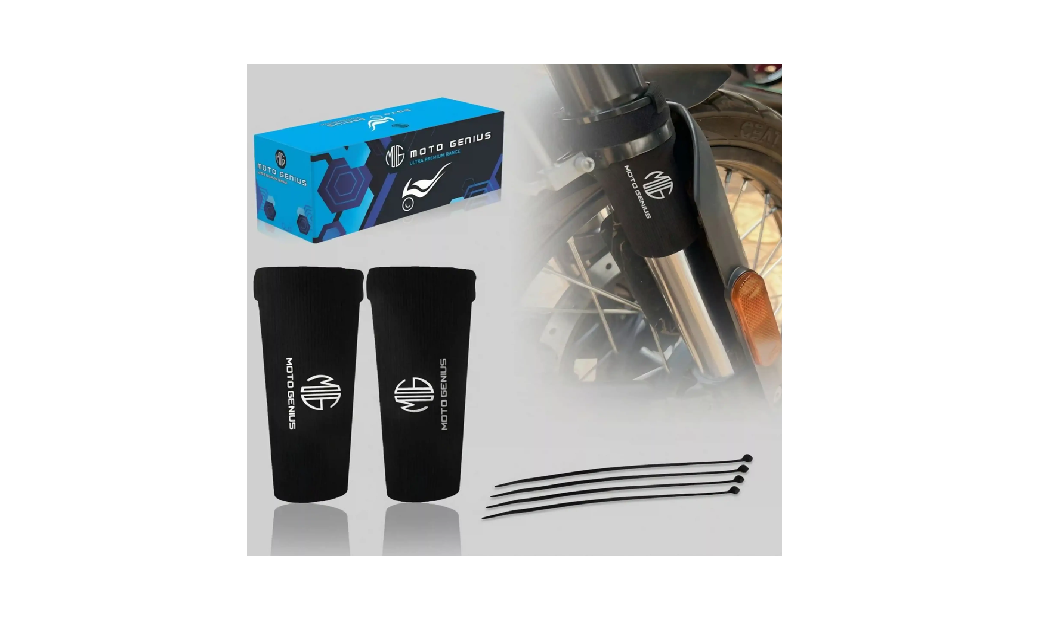
Yongkang Hongtian Motorcycle Front Fork Protector Instruction Manual
PRODUCT MANUAL
Product Information
- Product Name:Motorcycle Front Fork Protector
- Model: Subject to the picture or information sign
MANUFACTURER & EU REPRESENTATIVE INFO
- Manufacturer: Yongkang Hongtian Trading Co., Ltd.Changcheng Village, Yongkang Economic Development Zone, Jinhua City, Zhejiang Province Room 302, 3rd Floor, No. 66 Jinbi Road (self-declaration), 841996743@qq.com,86- 13018090962
- EU Authorized Representative: MJCM SARL,78 avenue des Champs Elysees Bureau 326,mjcm190928@gmail.com,33-767213611
Compliance Information
- This product is a protective accessory for motorcycle shock absorption systems. It is made of environmentally friendly materials, complies with relevant general safety and environmental protection standards of the European Union, and meets the sales requirements for the EU market.
Safety & Warnings
Safety Information
- Installation Requirements: After installation, ensure the sleeve is firmly fixed without loosening, and does not affect the normal telescopic stroke of the shock absorber, so as to avoid potential safety hazards caused by displacement during riding.
- Compatibility Warning: Only applicable to front shock absorbers with matching dimensions. Do not force installation on front forks of incompatible specifications to prevent impairment of shock absorption performance.
- Usage Restrictions: This product is an auxiliary protective accessory and cannot replace professional protective gear. Full protective gear must still be worn during intense off-roading or high-speed riding.
- Damage Replacement: Immediately replace the protective sleeve if it is torn, severely worn or detached, and do not continue to use it.
- Children’s Warning: Keep this product out of reach of children to prevent risks of accidental ingestion or suffocation.
Instructions for Use
- Installation Preparation
- Clean the piston rod and oil seal area of the front shock absorber to remove sediment, dirt and oil stains, and ensure the surface is clean.
- Confirm that the length and diameter of the protective sleeve are compatible with the front shock absorber, with no damage or deformation.
- Installation Procedures
- Stretch open the protective sleeve, fit it over the shock absorber from the lower or upper end, and adjust the position to fully cover the piston rod and oil seal area of the front shock absorber.
- Secure the protective sleeve with the built-in tightening strap or hook-and-loop fastener to ensure a tight fit without displacement, and it shall not affect the expansion and contraction of the shock absorber.
- Press the shock absorber to test its smooth expansion and contraction. It can be put into normal use if there is no jamming or interference.
- Storage and Maintenance
- Store the idle protective sleeve in a dry and ventilated place, avoid humid and high-temperature environments to prevent fabric aging and mildew.
- Wipe surface stains with a damp cloth for cleaning, and store it after air drying.
Maintenance and Care
- Regular Inspection: Check if the protective cover is loose, cracked or displaced before each ride. Adjust or replace it promptly if any abnormality is found.
- Cleaning and Maintenance: Rinse sediment off the surface of the protective cover regularly with clean water. It can be reused after air drying to prevent sediment accumulation from wearing the shock absorber oil seal.
- Replacement Cycle: Replace the protective cover with a new one in a timely manner when it loses elasticity, gets torn or suffers severe wear.
- Prohibited Operations: Do not pierce the protective cover with sharp objects; avoid contact with oil stains, strong acids, strong alkalis and other corrosive substances; do not bake it under high temperature.
Disclaimer
- The manufacturer and seller shall not be held liable for shock absorber malfunctions, riding accidents, personal injury or property damage caused by improper installation, use of mismatched shock absorbers, intentional damage, or failure to perform regular maintenance.